
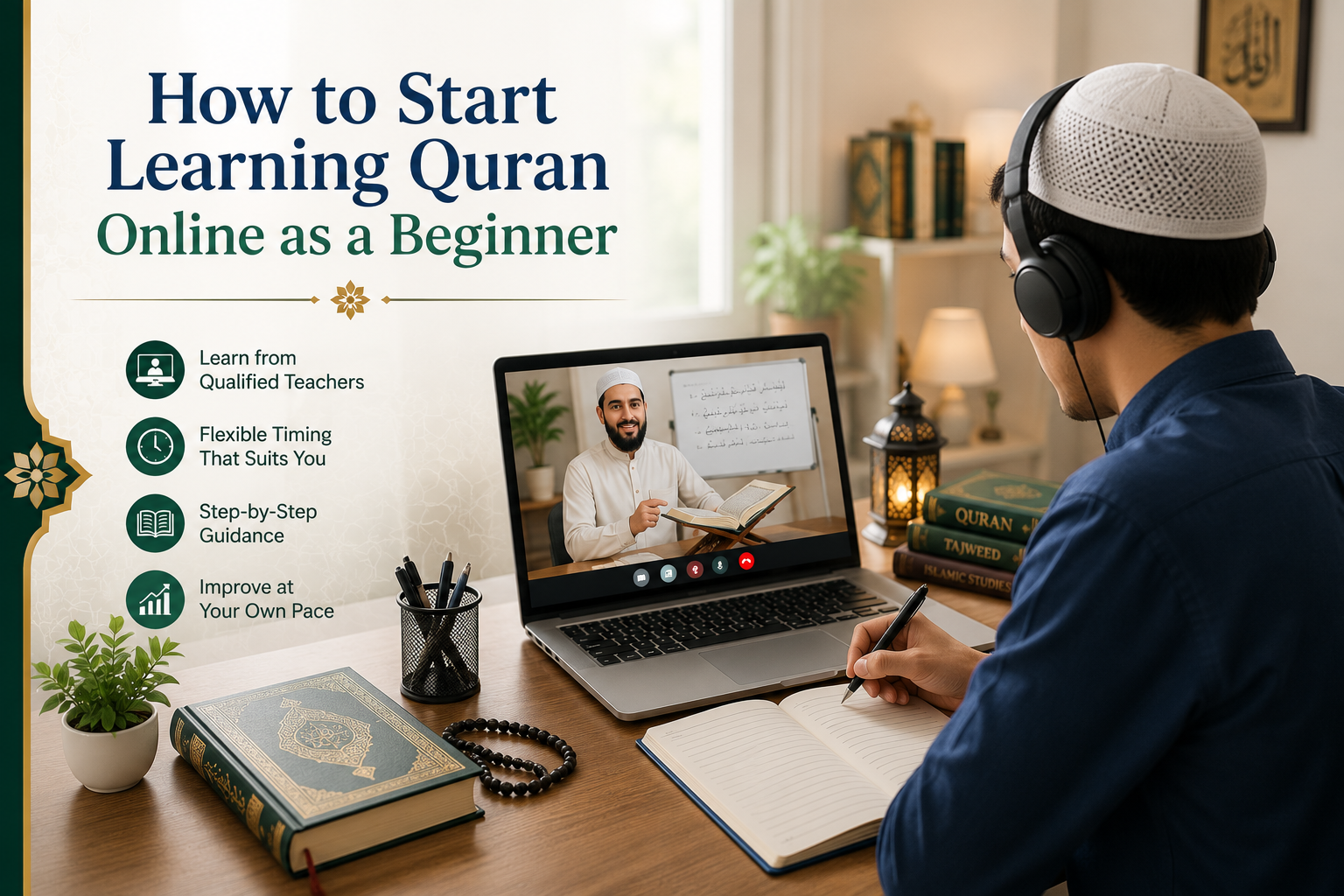
Starting something new is always a little intimidating and learning the Quran is no exception. Maybe you don’t know Arabic. Maybe you’re not sure how to read the letters, let alone recite with proper Tajweed. Maybe you tried once before and gave up after a week.
Here’s the good news: none of that matters right now. Every hafiz, every scholar, and every confident reciter you’ve ever admired started exactly where you are not knowing where to begin.
This guide walks you through the entire process, step by step, so you can start learning Quran online with confidence, structure, and a plan that actually sticks.
Why Learning Quran Online Works So Well for Beginners
A few years ago, learning Quran usually meant finding a local mosque, fitting into someone else’s schedule, and hoping the teacher was a good fit. Online quran learning UAE removed most of those barriers.
It gives you:
- One-on-one attention the teacher focuses only on you, not a room full of students at different levels
- Flexible timing early morning, late night, weekends, whatever fits your life
- Access to qualified teachers anywhere you’re no longer limited to who lives nearby
- A judgment-free pace beginners can go slow without feeling embarrassed in front of a group
- Consistency most academies offer 24/7 scheduling, so missed classes are easy to reschedule
For someone starting from zero, this flexibility is often the difference between quitting in week two and still learning a year later.
Step 1: Get Clear on Your Starting Point and Goal
Before picking a tutor or a course, take five minutes to be honest with yourself about two things:
- Where are you starting from? Do you know the Arabic alphabet at all? Can you recognize letters but not join them? Can you read slowly but want to improve Tajweed?
- What’s your goal? Learning to simply read the Quran is different from memorizing it (Hifz), which is different from understanding the meaning (Tafseer).
Most beginners fall into one of these starting points:
- Absolute beginner never learned Arabic letters
- Basic reader knows letters but struggles with joining and pronunciation
- Slow reader can read but wants fluency and correct Tajweed
- Ready to memorize reads well and wants to start Hifz
Knowing which of these describes you will decide the entire course structure your teacher builds for you.
Step 2: Start with Noorani Qaida (Yes, Even as an Adult)
If you’re a true beginner, the starting point is almost always Noorani Qaida a foundational booklet that teaches:
- Arabic alphabet recognition
- How letters change shape when joined
- Basic pronunciation rules (Makharij)
- Short and long vowel sounds
Adults sometimes feel embarrassed starting with a “children’s book,” but Qaida isn’t about age it’s about building the foundation correctly. Skipping it usually means developing pronunciation habits that are much harder to fix later. A few weeks of Qaida now saves years of correcting bad habits down the road.
Step 3: Choose the Right Online Tutor or Academy
This is the single most important decision you’ll make. A good teacher can make Quran learning feel achievable; the wrong fit can make you quit within a month.
Look for these when comparing tutors or academies:
| What to Check | Why It Matters |
| Qualified, certified teachers | Ensures correct Tajweed and pronunciation from day one |
| One-on-one classes | Beginners need individual pace, not group instruction |
| Free trial class | Lets you test teaching style before committing |
| Flexible scheduling | Keeps consistency easy around work, school, or family |
| Male and female teacher options | Comfort matters, especially for children and women |
| Structured curriculum | Shows the academy has a real beginner-to-advanced roadmap |
| Progress reports | Keeps you accountable and shows real improvement over time |
Most reputable academies, including platforms like Online Quran Tutors UAE, offer a free trial period before you commit to a paid package always use it. A short trial tells you more about teaching style and compatibility than any review ever could.
Step 4: Pick a Course That Matches Your Level
Once you know your starting point, match it to the right course:
- Nazra Quran & Qaida for absolute beginners learning the alphabet and basic reading
- Quran Reading (Beginners) for those moving from Qaida to fluent Quran reading
- Tajweed & Recitation for improving pronunciation, Makharij, and recitation rules
- Quran Memorization (Hifz) for those ready to begin structured memorization
- Translation & Tafseer for understanding meaning, context, and lessons behind the verses
- Basic Arabic Language helpful alongside any course to build vocabulary and comprehension
You don’t need to pick the “final” course on day one. A good teacher will assess you in the first class or two and recommend where to start.
Step 5: Set a Realistic, Consistent Schedule
Consistency beats intensity every time. Two focused 30-minute classes a week, attended reliably for six months, will get you further than five classes crammed into one week followed by silence.
A few tips that actually help beginners stick with it:
- Start with 2–3 classes a week rather than daily, so it doesn’t feel overwhelming
- Pick a fixed time slot same days, same time so it becomes a habit, not a decision
- Practice 10–15 minutes daily outside of class, even without a teacher
- Track your progress most academies provide monthly progress reports; use them
- Be patient with mistakes mispronunciations are part of learning, not a sign of failure
Step 6: Set Up the Right Learning Environment
You don’t need much, but a few basics make online classes smoother:
- Stable internet connection (Zoom or Google Meet, most commonly used)
- A quiet space with minimal distractions during class time
- A physical or digital Mushaf/Qaida to follow along
- Headphones, if possible, for clearer pronunciation feedback from your teacher
Common Mistakes Beginners Should Avoid
- Skipping Qaida to “jump straight to the Quran” this almost always backfires
- Choosing based on price alone a slightly higher-cost teacher with strong Tajweed knowledge is worth it
- Overcommitting early signing up for daily classes in week one often leads to burnout
- Not using the free trial always test compatibility before paying for a full package
- Comparing your pace to others everyone’s starting point and learning speed is different
Final Thoughts
Learning the Quran online as a beginner isn’t about being perfect from day one it’s about showing up consistently, starting with the right foundation, and learning from a teacher who’s patient with where you are. Start with Qaida if you need to, take the free trial classes seriously, and build a schedule you can actually maintain.
The letters will feel foreign at first. Give it a few weeks, and they won’t.
Frequently Asked Questions
- Can I really learn Quran online with no prior knowledge of Arabic? Yes. Most beginners start with zero Arabic knowledge. A structured course starting with Noorani Qaida is designed specifically for this.
- How long does it take to learn to read the Quran as a beginner? It varies by individual, but most beginners who attend classes consistently (2–3 times a week) become comfortable readers within 6–12 months.
- Is online Quran learning as effective as in-person classes? Yes, when it’s one-on-one. Many students actually progress faster online because of individual attention, flexible timing, and consistent scheduling.
- What age is best to start learning Quran online? There’s no age limit. Children as young as 4–5 can start with basic recognition, while adults of any age can begin with Qaida and build up from there.
- Do I need to buy anything before starting? Not necessarily. Most teachers provide digital Qaida and Quran materials during class. A notebook for notes and a quiet space are usually enough to begin.
- What’s the difference between Tajweed classes and regular reading classes? Reading classes focus on recognizing and reading Arabic text fluently. Tajweed classes go a step further, teaching the precise rules of pronunciation, stopping points, and recitation etiquette.
- Should I take a free trial class before committing? Always. A trial class shows you the teacher’s style, patience level, and teaching pace things no website description can fully convey.
- Can adults start Hifz (memorization) as beginners? Yes, though it’s usually recommended to first build strong reading and Tajweed skills before starting structured memorization, to avoid memorizing mistakes.
- How many classes per week should a beginner take? 2–3 classes per week is a sustainable starting point for most beginners, with short daily practice in between.
- What should I look for in an online Quran tutor? Certified qualifications, one-on-one teaching, a clear beginner curriculum, flexible scheduling, and a free trial class before you commit.