
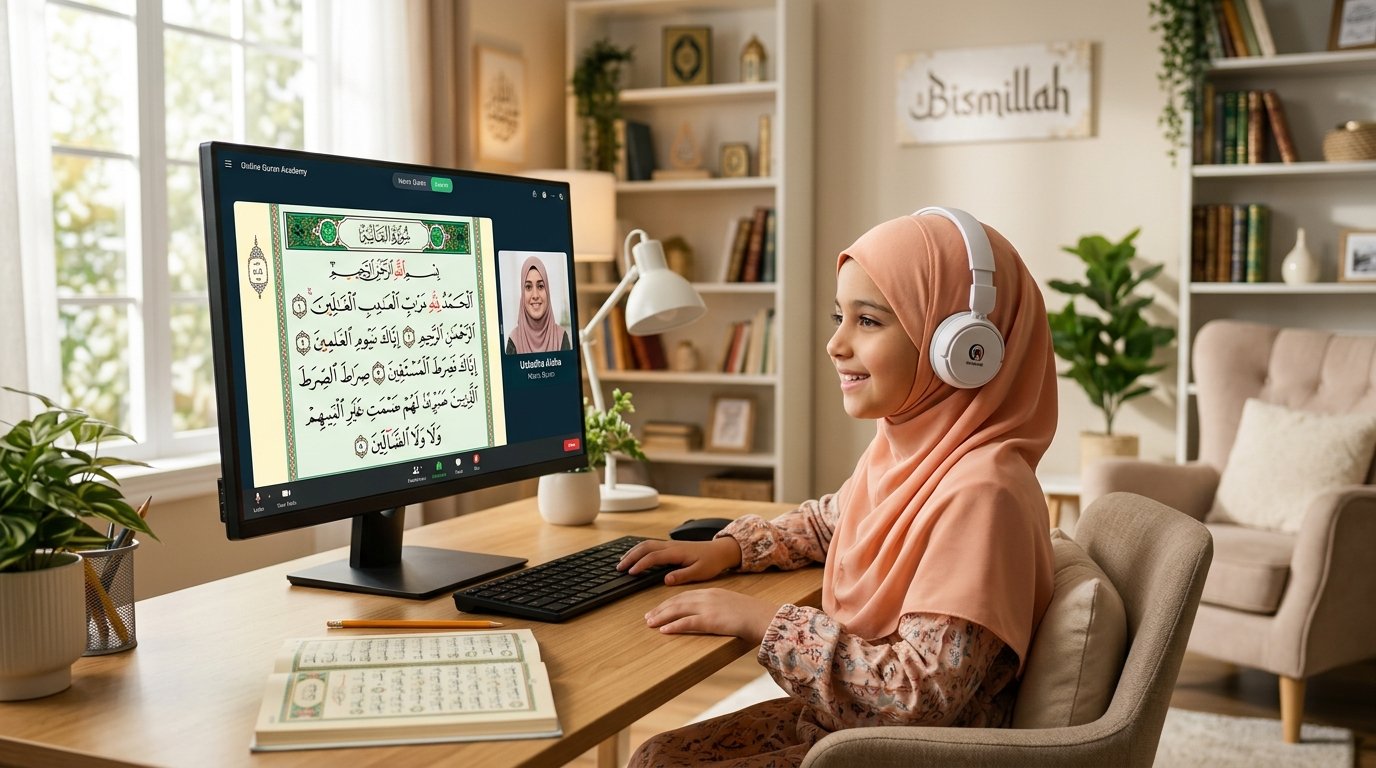
Nazra Quran Online vs. In-Person Classes: Which Is Better?
Most children can learn to read the Quran with ease. What makes the difference between lazy learners and those who seek guidance in reading Quran online tutors are a teacher and regular practice. Online Nazra Quran classes provide both, a qualified instructor and a flexible, guided plan only needing a device in the comfort of home.
What Is the Online Nazra Quran?
Online Nazra Quran is the process of being taught to read the Quran correctly from the mushaf, word by word, through video lessons from the teacher. Children learn to recognize the letters, blend them into words and read them with correct pronunciation. This is different to Hifz (memorization) and more in-depth Tajweed (rules of pronunciation and reading) which are often studied later.
Nazra usually follows Qaida, the primer for Quran reading, and is taught before Hifz and later Tajweed, which some parents elect to pursue for their children. Nazra is reading by sight, looking at the lines in the Quran and reading them, rather than reading by heart or being able to recite.
Children learn the same way as in a traditional class, minus the commute and greater focus on the individual student.
How Online Classes Improve Reading Skills
Students learn to recognize each letter, blend them into words and read them with correct pronunciation. With the help of a responsive instructor most children are able to become confident readers in just a few months.
- Recognizing each letter
There are many letters in Arabic that are similar but have diacritical markings, or the dots indicating how they are to be read, or are missing completely. A qualified instructor will use a variety of drills, games and exercises to help the child recognize each letter with confidence.
- Blending letters into words
Some letters are different depending on their position in a word. The instructor will guide the child from single letters into putting them together into two-letter words and then finally whole words.
- Practicing difficult sounds and letters
There are several letters ع, غ, ق, خ and ح that do not have a corresponding sound in the English alphabet and children tend to confuse them at first. Because online lessons are usually one-to-one, the teacher will hear the child’s incorrect pronunciation and be able to stop them from practicing it incorrectly.
- Learning basic Tajweed
It is common for children to skip learning Tajweed rules until later, but a brief introduction to what it entails will help them learn to read the Quran correctly. Learning from a teacher rather than a textbook makes it easier for children to understand and apply basic Tajweed rules when they are reading.
5.Gaining fluency
Fluency takes practice, and online classes are ideally structured to gain it. There is usually a short revision of the last lesson followed by learning something new and then a short solo reading by the child to encourage fluency and confidence.
Why Learning From Home Is Best For UAE Families
Learning from home removes the commute and fits better in the daily schedule of UAE families, encouraging regularity and discipline. Children who practice reading Quran at home are more likely to develop the muscle memory necessary to become a fluent reader.
School, errands and other activities tend to fill up afternoons for many UAE families, and leaving the house to go to and from a class can eat into precious learning time. With online Nazra Quran classes, the commute is eliminated, and students can be scheduled at a time that works best for their families. The home environment also allows the student to pay attention better in a familiar space.
If a class is missed due to another engagement, it is much easier to reschedule an online class than it is to find a parent and student who are free at the same time for an in-person class.
Child-friendly Techniques
A child-friendly instructor uses techniques that keep the student engaged and wants to practice reading the Quran. Children learn best without the fear of making mistakes, and a responsive teacher will not punish or berate them but explain why a mistake was made.
Key child-friendly techniques are:
- Short, focused lessons (usually 25-30 minutes for younger children)
- Visual aids to indicate the current line or word being read
- No shame or anger if a mistake is made
- Praise and encouragement throughout the lesson
- Encouraging rather than demanding practice (reading a line without pause) rather than long, continuous readings
The Parent’s Role
The most important thing that a parent can do is encourage regularity and practice, and create a conducive learning environment, especially for younger students who are easily distracted.
They do not need to know Arabic or be able to read Quran themselves. Other things that parents can do to support their child’s learning are:
- Set aside a regular time and place for classes
- Ensure that mushaf or screen is at eye level
- Ask for a brief weekly summary from the teacher
- Ask the child to “teach” something they have learned
- Practice reading Quran at home, for 10-15 minutes rather than one long session before the lesson
Learning alongside other children
Neither option is perfect for every child, but a student who struggles to pay attention in front of a screen would benefit from attending a class in person, while someone who needs more one-on-one help would benefit from taking Nazra online.
Younger children may need help from parent using device
Added screen time
Less peer interaction
Varying quality between academies, requiring research
How To Choose A Teacher/Academy
Choose a teacher who can show proper application of Tajweed rules and has experience teaching children. Ask to trial a class before you make any commitments. Inquire about method of instruction and parental involvement.
Recommendations:
- Ask to see qualifications, including experience of teaching Quran to children
- Trial class: observe how teacher gives corrections
- Ask about structure of classes including revision, new material and progress tracking
- Confirm if class is one-to-one or in a group
- Ask about scheduling to fit in your child’s other activities
- Avoid making decisions based on exaggerated claims or promises
Online Quran Tutors UAE offers online Nazra Quran for children, with a focus on correct reading technique, child-friendly methods and flexible scheduling for UAE families. Parents are encouraged to ask about teacher qualifications and trial the class before enrollment.
Common Mistakes
- Skipping Qaida
Children must learn the letters, sounds and rules of Qaida before embarking on Nazra. Skipping this will result in incorrect letter recognition and pronunciation.
- Rushing pages
Children must be able to read a line without pause before advancing to the next. Rushing will create bad habits that are hard to correct.
- Inconsistent attendance
Attending two classes a week with no practice in-between will not lead to progress.
- Not practicing at home
Even 10 minutes of practice a day makes a noticeable difference.
- Choosing only on price
A teacher’s ability to correct a student’s pronunciation is more important than a low rate.
- Comparing siblings
Children have different needs and learning abilities. One may benefit from online classes while another learns better in-person.
Quick Checklist for Parents
My child knows (or is learning) Arabic letters via Qaida
I have a quiet space, a stable connection and a mushaf
Classes are at a consistent time
I have asked for a trial class
Daily 10–15 minute practice is planned
I get regular progress updates
Key Takeaways
- Nazra is reading the Quran correctly by sight, and is the prerequisite for Hifz and advanced Tajweed.
- Live correction is the main advantage of online one-to-one classes.
- Consistency and frequent, short practice sessions are more important than long ones.
- Parents do not need to know Arabic, but should ensure a suitable learning environment.
- Always trial a teacher before making any commitments.
Frequently Asked Questions
What is online Nazra Quran for kids?
It is live, teacher-led instruction in reading the Quran from the text with correct pronunciation. Children learn through video lessons at home, usually after finishing Qaida.
What age can a child start Nazra?
Many children start between ages 5 and 7, once they can sit for short lessons and recognize letters. Readiness varies, so a teacher can assess your child in a trial class.
How long does it take a child to read the Quran fluently?
It depends on age, starting level and practice. Some children read confidently within months, others take longer. Be wary of any academy that guarantees a certain timeline.
Do children need Qaida before Nazra?
Usually yes. Qaida teaches letters, vowels and basic joining. Without it, children often struggle to read accurately.
Is online learning as effective as in-person classes?
It can be, with one-to-one attention and parent support. Effectiveness depends on the teacher, the routine and the child’s focus.
How long should each lesson be?
Around 25 to 30 minutes suits many younger children. Older children can handle 30 to 45 minutes.
Does my child need Tajweed in Nazra?
Basic Tajweed is introduced gradually during Nazra so the child reads correctly. Detailed rules usually come later.
What do we need to start?
A device with a camera and microphone, a stable internet connection, a quiet corner and a mushaf.
Can parents sit in on classes?
Yes, and it is recommended for younger children. It helps you support practice at home.
Conclusion
Online Nazra Quran classes enable children to read more accurately because a teacher can hear, correct and guide them in real time, without the rigidity of in-person classes. Building a confident reader requires gradual, guided practice: letters, joining, pronunciation, basic Tajweed and regular sessions at home. Ready to see how it works for your child? Book a trial class with Online Quran Tutors UAE and meet a teacher before you decide.