
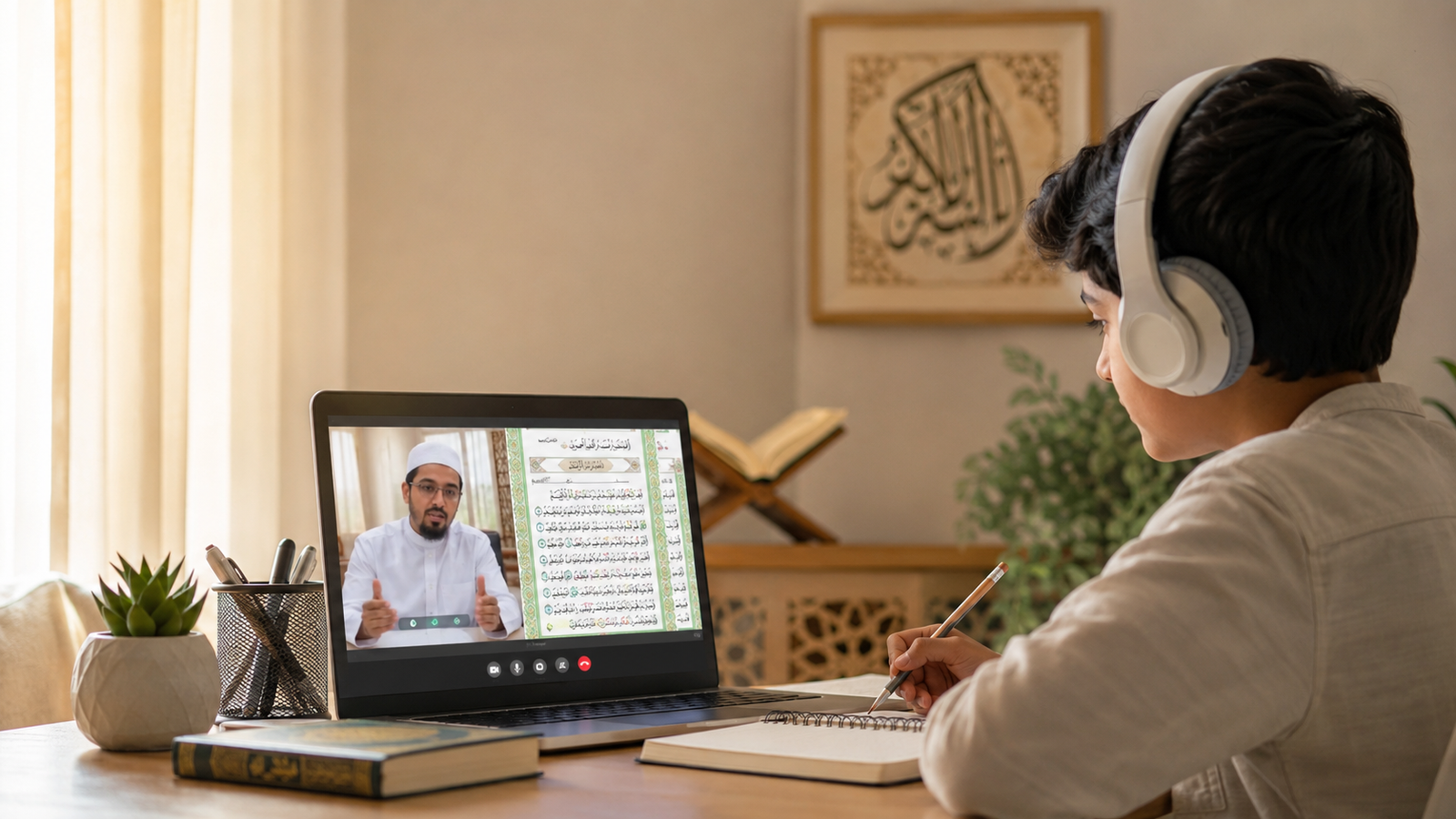
Finding the right way to learn Online Quran in UAE isn’t always simple. Work schedules, school runs, and traffic make it hard to commit to a fixed class time across town. That’s the main reason online Quran classes have become the practical choice for many families and adults across the UAE they remove the commute without removing the structure of proper learning.
This guide walks through how online Quran classes actually work, what a fair price looks like, how to tell a qualified tutor from an unqualified one, and the mistakes that quietly slow down a student’s progress.
What Are Online Quran Classes?
Quick answer: Online Quran classes are one-on-one or small-group Quran lessons delivered over video call, where a qualified tutor teaches Quran reading, Tajweed rules, memorization (Hifz), and Tafsir using screen-sharing tools, digital Mushafs, and live correction the same core teaching method used in traditional classes, just delivered remotely.
Instead of sitting physically in front of a teacher, the student joins a scheduled video session usually through Zoom, Google Meet, or a dedicated learning platform. The tutor listens to recitation in real time, corrects pronunciation immediately, and tracks progress lesson by lesson, similar to how a private tutor would work in person.
Most programs are structured around a few core tracks:
- Noorani Qaida – for absolute beginners, covering Arabic letters and basic pronunciation
- Quran reading with Tajweed – correct recitation rules
- Hifz (memorization) – structured memorization with revision cycles
- Tafsir – understanding the meaning and context of verses
- Islamic studies – for students who want broader religious education alongside Quran
Why Families in the UAE Are Choosing Online Learning
Dubai and the wider UAE have a highly mobile population many residents are expatriates without an extended family network nearby, and both parents often work full-time. Online Quran classes solve a scheduling problem that in-person classes can’t: a tutor in one emirate, or even outside the country, can teach a student in Dubai or Abu Dhabi without either party leaving home.
There’s also a quality factor. Because the Online Quran tutor pool isn’t limited to a single neighborhood, families can choose from qualified Huffaz and certified teachers across a much wider range, rather than settling for whoever happens to be available locally.
How Online Quran Classes Work
Quick answer: A typical online Quran class runs 30–60 minutes, one-on-one or in a small group of 2–4 students, scheduled at a fixed weekly time, using video call software and a shared digital Mushaf so the tutor can follow along and correct the student in real time.
Here’s what a first month usually looks like:
- Trial class – most reputable platforms offer a free or low-cost trial so the student and tutor can assess fit
- Level assessment – the tutor evaluates current reading ability or memorization level
- Personalized plan – a lesson plan is built around the student’s pace, whether that’s Qaida basics or advanced Hifz
- Weekly recurring sessions – usually 2–5 sessions per week depending on the package
- Progress tracking – many tutors keep a simple log of what’s been covered and what needs revision
- Parent updates – for children’s classes, tutors typically share short progress notes after each session
What to Look for in an Online Quran Tutor
Quick answer: A qualified online Quran tutor should have a verifiable Ijazah (certification) in Quranic recitation, teaching experience specifically with the age group you need (children vs adults), fluency in the student’s preferred language, and a teaching style that includes real-time correction rather than passive listening.
A few things worth checking before committing to a package:
- Ijazah or certification – ask directly which qanoon (chain of transmission) or certifying institution issued it
- Experience with your child’s age group – teaching a 6-year-old is a different skill from teaching a teenager or adult
- Trial class availability – any tutor confident in their teaching should be comfortable offering one
- Communication language – especially important for non-Arabic speaking families
- Class recording policy – useful for revision, and worth confirming upfront
- Flexibility on rescheduling – life happens; check the cancellation policy before paying for a term
Avoid tutors who avoid direct questions about their credentials, or who push long-term contracts before a trial class has even happened.
Typical Cost of Online Quran Classes in UAE
Quick answer: Online Quran classes in the UAE generally range from around AED 150 to AED 400 per month for 2–3 weekly sessions, depending on whether it’s group or one-on-one, the tutor’s experience level, and whether the focus is basic reading or full Hifz memorization. Prices vary by provider, so treat this as a general range rather than a fixed figure.
Factors that typically affect price:
- One-on-one classes cost more than group classes
- Hifz (memorization) programs often cost more than reading-only programs
- Native Arabic-speaking tutors with formal Ijazah sometimes charge a premium
- Daily classes cost more overall than 2–3 sessions per week, though the per-session rate is often lower
It’s worth asking for a clear breakdown of what’s included session length, number of sessions per week, and whether revision time is factored in rather than comparing platforms on price alone.
Online vs In-Person Quran Classes
| Factor | Online Classes | In-Person Classes |
| Commute | None | Required |
| Tutor choice | Wide, not limited by location | Limited to local area |
| Scheduling flexibility | High | Lower |
| One-on-one attention | Common | Depends on class size |
| Learning environment | Home, can have distractions | Structured classroom setting |
| Cost | Often comparable or lower | Varies by institute |
| Parent supervision (for kids) | Easier, parent is nearby | Limited during class |
Neither format is universally better a highly self-disciplined student may do just as well online, while a child who’s easily distracted might benefit from the structure of an in-person classroom. It often comes down to the individual student’s learning style.
Common Mistakes Parents and Students Make
- Skipping the trial class – committing to a monthly package without testing tutor fit first
- Choosing based on price alone – the cheapest option isn’t always the most effective long-term
- Not setting up a distraction-free space – a noisy room undermines even a good tutor’s efforts
- Inconsistent attendance – irregular sessions slow Hifz progress significantly
- Not asking about the tutor’s Ijazah – assuming fluency in Arabic equals qualification to teach Tajweed
- Overloading the schedule – signing up for daily Hifz classes without checking if the pace suits the student’s age and workload
- Ignoring revision time – memorization without structured revision is quickly forgotten
Expert Tips for Faster, More Consistent Progress
- Keep a fixed schedule. Same days, same time this builds a habit faster than sessions scattered across the week.
- Use headphones during class. Reduces background noise and improves the tutor’s ability to correct pronunciation accurately.
- Review for 5–10 minutes daily, even outside scheduled class time short daily revision beats occasional long sessions.
- Ask the tutor for a monthly progress summary. This keeps expectations realistic and highlights where extra focus is needed.
- For children, sit nearby during early sessions without interrupting it helps with focus and lets you understand what’s being taught.
Pros and Cons of Online Quran Learning
Pros
- No commute, saves time for busy families
- Wider choice of qualified tutors
- Often more flexible rescheduling
- Comfortable, familiar learning environment
- Easier to monitor for parents
Cons
- Requires a stable internet connection
- Can be harder to manage for students prone to distraction
- Less face-to-face classroom interaction
- Technical issues can occasionally disrupt sessions
Checklist: Before You Book Your First Class
- Confirmed the tutor’s Ijazah or certification
- Booked and attended a trial class
- Clarified the total monthly cost, including all sessions
- Checked the cancellation/rescheduling policy
- Set up a quiet, distraction-free space with headphones
- Agreed on a fixed weekly schedule
- Asked how progress will be tracked and communicated
Key Takeaways
- Online Quran classes in UAE follow the same core teaching method as in-person classes, delivered by video call
- A trial class is the best way to judge tutor fit before committing
- Costs generally range from AED 150–400/month depending on format and tutor experience
- Consistency matters more than session length for steady progress
- Always verify a tutor’s Ijazah before starting a long-term plan
FAQs
- Are online Quran classes as effective as in-person classes? For most students, yes especially when the tutor provides real-time correction and the student attends consistently. Effectiveness depends more on tutor quality and consistency than on the format itself.
- What age can a child start online Quran classes? Most platforms accept children from around age 5–6, once they can sit through a short structured session and follow basic instructions.
- How many days a week should a beginner take classes? 2–3 sessions per week is a common starting point for beginners, increasing to daily sessions for students focused on Hifz.
- Do I need special equipment for online Quran classes? A stable internet connection, a laptop or tablet, and headphones are usually enough. A printed or digital Mushaf helps the student follow along.
- Can adults join online Quran classes, or is it only for children? Adults, including complete beginners and reverts to Islam, make up a significant portion of online Quran students. Many platforms offer separate tracks for adult learners.
- How do I know if an online Quran tutor is qualified? Ask directly about their Ijazah, which institution or scholar certified them, and their teaching experience with your specific age group or learning goal.
- What’s the difference between Qaida and Tajweed classes? Qaida teaches the basics of Arabic letters and pronunciation for absolute beginners. Tajweed builds on that foundation, teaching the precise rules of correct Quranic recitation.
- Is it possible to complete Hifz (full memorization) through online classes? Yes, many students complete full Hifz through structured online programs, though it typically requires daily sessions and significant revision discipline over several years.
Conclusion
Online Quran classes have become a practical, credible way for families across the UAE to give their children or themselves consistent, personalized Quran education without the constraints of commuting or fixed local tutor availability. The format works well when paired with a qualified tutor, a distraction-free space, and a consistent weekly schedule.
If you’re ready to see how this works in practice, book a free trial class and judge tutor fit for yourself before committing to a monthly plan.