
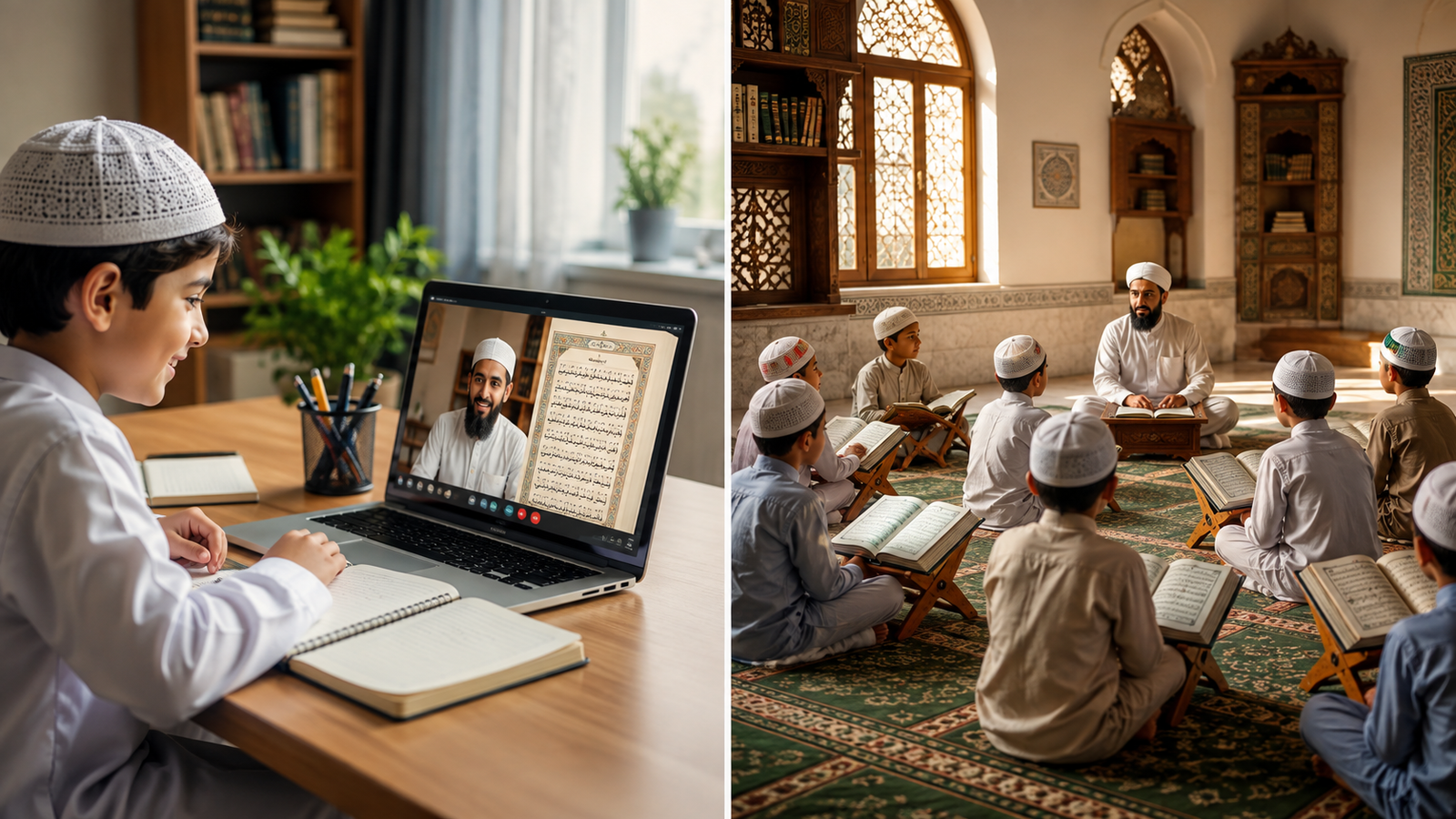
Choosing between Online Quran classes and a traditional madrasa is one of the most common decisions Muslim families in Dubai face today. Both paths can produce a strong, accurate understanding of the Quran but they get there very differently, and the right choice depends on your schedule, your child’s learning style, and what you’re hoping to achieve.
This guide compares both options honestly, without favoring one just because it’s newer or more familiar. By the end, you’ll know exactly which path fits your situation, and what to check before you commit.
What Are Online Quran Classes and What Is a Traditional Madrasa?
Quick answer: Online Quran classes connect a student with a qualified Quran teacher over video call, using screen sharing and digital Mushaf pages for real-time correction. A traditional madrasa is a physical institution where students attend in person, usually in groups, following a set timetable and classroom structure.
Both aim to teach the same core skills: correct Quran reading (Tajweed), memorization (Hifz), and understanding of basic Islamic knowledge. The difference lies in how that teaching is delivered, not in what’s being taught.
A madrasa has existed for centuries as the traditional model of Islamic education, often attached to a mosque, with a teacher instructing multiple students at once. Online Quran classes are a newer format that became widely accepted over the last decade, especially after families in the UAE and abroad experienced remote learning firsthand and saw it could genuinely work for Quran study too.
How Online Quran Classes UAE Actually Work
Quick answer: A student logs into a video platform at a scheduled time, the teacher listens to recitation live, points out mistakes immediately, and assigns practice for the next session the same correction loop as in-person learning, just through a screen.
A typical session with an online Quran tutor in UAE follows this pattern:
- The student joins a one-on-one or small-group video class at a pre-booked time.
- The teacher shares a digital Quran page or uses a physical Mushaf visible on camera.
- The student recites; the teacher corrects pronunciation, Tajweed rules, and pacing in real time.
- New lines or Surahs are assigned for memorization or revision.
- Progress is tracked, often through a parent dashboard or weekly report.
Because sessions are one-on-one in most reputable programs, including at Online Quran Tutor, the teacher can focus entirely on one student’s mistakes rather than dividing attention across a classroom of fifteen or twenty children which is one of the genuine advantages online learning offers over group-based madrasa classes.
How a Traditional Madrasa Works
Quick answer: Students attend a physical location on a fixed schedule, usually in a group setting, following a structured curriculum set by the institution, with direct face-to-face interaction and a strong community and discipline element.
Madrasas typically operate either as full-time institutions or part-time after-school programs attached to a mosque. Class sizes vary widely some offer small, focused groups, others teach larger batches where a single teacher manages many students at once. The structure tends to be more rigid: fixed hours, fixed location, and a curriculum that moves at the pace of the group rather than the individual.
The community aspect is a real strength here. Children build friendships with peers going through the same memorization journey, and the physical presence of a teacher and institution reinforces discipline and consistency for many families.
Comparison Table: Online Quran Classes vs Traditional Madrasa
| Factor | Online Quran Classes | Traditional Madrasa |
| Location | Anywhere with internet | Fixed physical location |
| Class format | Usually one-on-one | Often group-based |
| Schedule flexibility | High reschedule easily | Low fixed timetable |
| Commute | None | Required, adds travel time |
| Teacher attention | Fully focused on one student | Divided across the class |
| Peer interaction | Limited | Strong |
| Cost structure | Pay per session/month | Often term-based fees |
| Progress tracking | Digital reports common | Varies by institution |
| Suitable for | Busy families, travelers, individualized pace | Families wanting community, structure, in-person discipline |
Cost Comparison
Quick answer: Online Quran classes in the UAE generally cost less per hour than a private madrasa because there’s no facility overhead, though fees vary by provider and by whether classes are one-on-one or group-based. Madrasa costs depend heavily on the institution, ranging from low community-mosque rates to higher private-school-style fees.
Online tutoring often becomes more cost-effective per learning hour because the student gets undivided one-on-one attention rather than sharing a teacher’s time across a group meaning fewer wasted minutes per session. That said, exact pricing varies by provider, so it’s worth requesting a clear breakdown before enrolling anywhere.
Quality of Learning: Can an Online Quran Tutor Match a Madrasa Teacher?
Quick answer: Yes, when the Online Quran tutor is properly qualified Ijazah-certified, experienced in Tajweed instruction, and using real-time video correction the learning quality can match or exceed a group madrasa class, because individual attention often produces faster, more accurate correction than a divided classroom.
This is the question most parents genuinely worry about, and it deserves an honest answer: quality depends on the teacher, not the format. A poorly trained teacher online is no better than a poorly trained teacher in a classroom. What matters is:
- Whether the teacher holds a verified Ijazah (chain of certification) in Quran recitation.
- Whether Tajweed correction happens live, not after the fact.
- Whether the teacher has real experience with children or adult beginners, depending on the student.
- Whether progress is measurable, not just “attendance.”
In practice, one-on-one online correction can catch mistakes a group class would miss, simply because the teacher isn’t managing fifteen other students at the same time.
Flexibility and Schedule
Quick answer: Online Quran classes fit around work, school, and travel because sessions can be rescheduled and accessed from anywhere, while a madrasa requires committing to a fixed time and physical location every week.
For families in Dubai juggling school runs, work meetings, and multiple children’s activities, this flexibility is often the deciding factor. It also matters for families who travel frequently or split time between countries an online Quran teacher travels with the student, a madrasa doesn’t.
Who Online Quran Classes Are Best For
- Working parents with unpredictable schedules
- Children who learn better with individual attention
- Families who travel often or live far from a madrasa
- Adult learners and new Muslims who feel shy in a group setting
- Students needing a specific focus, like Tajweed correction or exam preparation
Who a Traditional Madrasa Is Best For
- Families who value in-person community and peer motivation
- Children who thrive with structured, fixed routines
- Students who benefit from group accountability
- Families with a trusted, well-established local madrasa nearby
Common Mistakes Families Make When Choosing
- Choosing based on price alone, without checking the teacher’s actual qualifications or Ijazah.
- Assuming online means less serious, and therefore not holding the student accountable for practice between sessions.
- Picking a group class for a child who needs one-on-one attention, then blaming the format when progress is slow.
- Not requesting a trial class before committing to a term or package.
- Ignoring teacher-student fit personality and teaching style matter as much as method.
Expert Tips for Getting the Most From a Quran Teacher Online
- Ask for the teacher’s Ijazah and years of teaching experience before the first session.
- Request a free trial class to check communication clarity and internet stability.
- Keep a consistent weekly schedule even though online classes are flexible consistency drives memorization more than flexibility does.
- Use a proper Mushaf during class rather than relying only on a screen, to build a real physical connection with the text.
- Review progress reports regularly rather than assuming steady improvement.
Pros and Cons Summary
Online Quran Classes
- Flexible scheduling, no commute
- One-on-one focused correction
- Accessible from anywhere
- Requires stable internet and a quiet space
- Less peer interaction
Traditional Madrasa
- Strong community and peer accountability
- In-person discipline and structure
- Fixed schedule, commute required
- Attention divided across a group
Checklist: How to Choose the Right Option
- Confirm the teacher’s Ijazah and certification
- Compare cost per learning hour, not just monthly fee
- Book a trial class before committing
- Match the format (one-on-one vs group) to your child’s learning style
- Check schedule flexibility against your family’s routine
- Ask about progress tracking and reporting
- Consider whether community interaction matters to your child
Key Takeaways
- Both online Quran classes and traditional madrasas can produce excellent results the teacher’s qualification matters more than the format.
- Online Quran classes UAE offer stronger flexibility and individual attention; madrasas offer community and in-person structure.
- Always verify Ijazah certification and request a trial class before enrolling anywhere.
- The right choice depends on your child’s learning style and your family’s schedule, not on which option is trendier.
FAQs
- Are online Quran classes as effective as a traditional madrasa? Yes, when taught by a qualified, Ijazah-certified teacher using live correction, online classes can be just as effective often more focused, since attention isn’t divided across a group.
- How much do online Quran classes cost in the UAE? Pricing varies by provider and whether classes are one-on-one or group-based. It’s best to request a clear rate breakdown directly from the provider before enrolling.
- What equipment do I need for online Quran classes? A stable internet connection, a laptop or tablet with camera and microphone, and a physical Mushaf are usually sufficient.
- Can adults join online Quran classes, or is it only for children? Both. Many adult learners, including new Muslims, prefer online classes because they’re more private and less intimidating than a group madrasa setting.
- How do I know if an online Quran tutor is qualified? Ask directly for their Ijazah (certification chain), teaching experience, and whether they specialize in Tajweed, Hifz, or beginner instruction.
- Is a madrasa better for discipline than online classes? Madrasas offer strong in-person structure and peer accountability, which suits some children well. Online classes can build similar discipline through consistent scheduling and parental involvement.
- Can online Quran classes help with Tajweed specifically? Yes live video correction lets the teacher hear and correct pronunciation in real time, which is the core requirement for proper Tajweed learning.
- Is it possible to switch from a madrasa to online classes mid-year? Generally yes, though it’s worth discussing the transition with the new teacher so they understand what the student has already covered.
- Do online Quran classes offer trial sessions? Reputable providers, including Online Quran Tutor, typically offer a free or low-cost trial class so families can assess fit before committing.
- Which is more suitable for busy families in Dubai? Online Quran classes usually work better for families with unpredictable schedules or long commutes, since sessions can be arranged around existing commitments.
Conclusion
There’s no single right answer between online Quran classes and a traditional madrasa only the answer that’s right for your family. If flexibility, individual attention, and convenience matter most, Best Online classes are worth serious consideration. If community, in-person structure, and peer accountability matter more, a well-run local madrasa remains a strong choice.
What matters most, regardless of format, is the teacher’s qualification and how consistently the student practices between sessions.
Ready to see the difference for yourself? Book a free trial class with a certified Online Quran Tutor and experience one-on-one, Ijazah-certified instruction built around your schedule.